
DNF
Disappointment in the Bighorn Mountains

Hey Friends,
Here’s another old story I wrote that hasn’t quite seen the light of day. It’s a few years old at this point. This was before the big, “Elk Fire” that ran through the Tongue canyon area last year. Word is the race is still going to happen his year, so I’m glad it didn’t have as big an impact as it seemed that it would.
It’s also worth remembering that the Bighorn Trail races were originally set up in 2002 to raise public awareness about these beautiful areas and avert damaging hydroelectric development1.
“These runs were initially started by local trail runners interested in preserving and protecting the Dry Fork and Little Bighorn River Canyons from a planned pump storage hydroelectric project and other development. We desired to increase public awareness of the natural beauty, rugged terrain, and unique geology of the Bighorn Mountains and Dry Fork and Little Bighorn River drainage in particular so that informed decisions could be made regarding the management of these resources. Through extensive public input, the planned pump storage hydroelectric project has been placed on hold and probably is dead; but the area remains potentially threatened in the future by other possible development.”
- The Bighorn Trail Races website.
Public lands are more at risk than ever, especially for these unnecessary, poorly thought out projects.
Food for thought. Have a great week, friends!
Sean
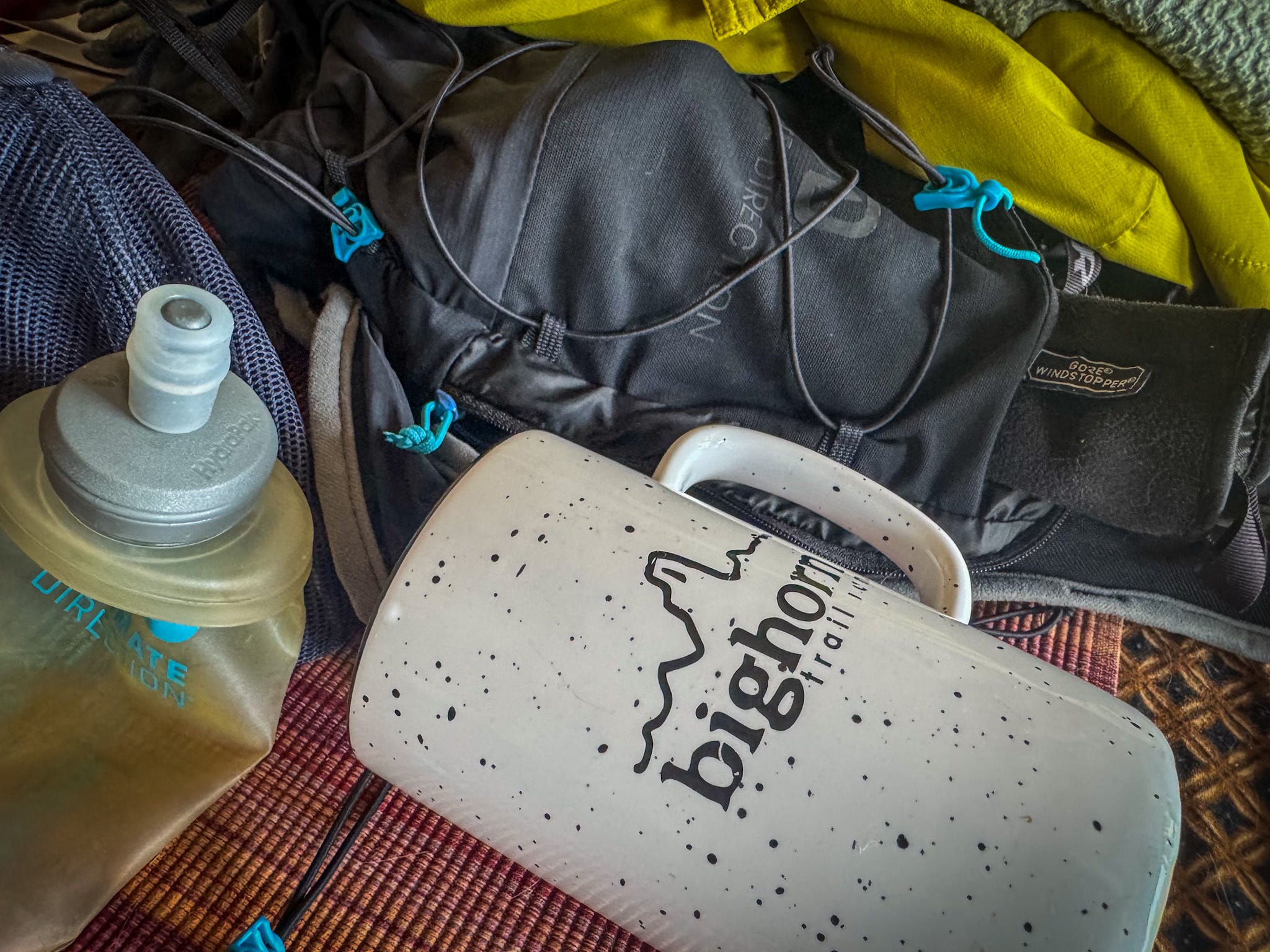
I convinced my buddy to run the Bighorn 100M. He convinced me to run it with him. Two solid weeks after the race, I feel very conflicted about what happened.
The Bighorn was my first 100M race. I ran it in 2017, whose conditions were famously terrible: nearly half the course was either ankle deep mud or underwater. I finished with 15 minutes to spare.
As with most ultra running experiences, the memories grew fonder as they faded into the distance. I’ve been wanting to go back ever since.
I chose Bighorn because it was both a Western States and a Hardrock qualifier. At the time I wanted to run both. I was upset about my stagnant running, having only put down a few 50k’s and the infamous Squamish 50 Miler.
I still remember the emotional evening spent writing in my notebook. Lamenting my lack of progress towards what I thought of as lifetime goals. I’m glad I went through that micro crisis. Rational as I like to be, it’s hard to imagine seriously reprioritizing your life without some kind of emotional blow up.
Did everything work out as I had hoped? Not even close. But I’m glad it happened. Gnarly 100 Milers are far and away my favorite expression of running.
This year was going to be Les’ first 100 Miler, and of course I wanted him to share in my joy for the sport.
It was supposed to be 97 degrees in Tongue canyon. It was hot, sure, but we stopped to dunk ourselves in the abundant stream water at every opportunity.
Les drank four bottles to my three. We barely noticed the heat. We moved slowly, but still ran. This time around, I was able to really take in the scenery. The Bighorn mountains are breathtaking.
We were slow but pretty methodical. We didn’t stop more than we needed to, although it took a while to find my drop bag at JAWS.
Running in the night was fine, and we did experience the typical Bighorn swamp above 8500’. We changed socks as we turned around at Elk Camp and everything felt just fine.
I started limping at sunrise, as we were making our way back down to Sally’s Footbridge. It was painful and the miles were almost unacceptably slow. We were constantly surprised at how long it took us to get three miles. Or five.
I managed to fix my limp, but Les was still running slower than I was walking. It was his first race - and I wasn’t exactly pacing - so I wanted him to do it his way. In retrospect I should have pushed us harder.
But I was also growing paranoid about that ankle.
I decided to start running about 3 miles out from Sally’s. I certainly should have communicated better with Les, but it was like hour 23 into the race! I figured he’s chase after me.
I’ve never run that far with someone before, and come to think of it - I’ve never had to push myself with other people around. There comes a moment in most 100 Milers were you start to growl - to vocally spite the amorphous pain and fatigue - and get back into running shape.
Folks often talk about how pain fluctuates violently in 100 mile races. What I learned this time around is that such a statement is only true if you actively push through the pain to try to shake it. The “death march” phenomena is a fixed point in effort. You literally have to faster run through the exhausting and the pain to get out of it. It will not go away on its own.
Or at least that’s my current thinking on that.
I got my ankle wrapped at Sally’s and called it quits when the medic pushed into my shin.
“Ow!” I cried out, not expecting that. Neither was she.
“I was fine with you continuing until that.” She said. So I didn’t. My buddy came into the aid station a few moments later. We had 15 minutes to get out before cutoff.
As I sit here with my healing ankle, I have mixed feelings about not pushing past Sally’s. It was only a 50k until the finish line. Would I have really pushed my shin into stress fracture territory? Do I have a stress fracture now? I doubt it. I’ve been pain free for a while.
I’m fine with my own irresponsibility: inadequate training leading to increased chances of failure. I don’t need to finish all the 100 Milers I start - although I’d love to and it has sucked both times I’ve had to drop. But what pains me here is that I failed my friend. I could have done more. I probably should have pushed him more to continue.
Just another lesson in becoming a better friend and a better ambassador for the sport.
Pump storage hydroelectric power essentially amounts to using a water reservoir as a battery. These can complement the usage of variable energy sources such as wind or solar power. But the nice thing about gravity feed hydro power is that we can place them anywhere. That doesn’t mean we should put them everywhere. It’s important to balance these concerns with our ability to get out and enjoy wide open spaces.